|
The Center for Arms Control and Non-Proliferation is the Council’s affiliated 501(c)(3) research organization. |
|
FEBRUARY 5 BEGINS NEW AGE WITHOUT TREATY-MANDATED In less than three weeks, we will wake up in a world we have not known in more than 50 years: one without constraints on the world’s two largest nuclear arsenals. The New Strategic Arms Reduction Treaty (New START) is no longer in force beginning February 5, leaving Russia and the United States free to build up their nuclear arsenals again — with none of the transparency or verification measures that made the treaty successful. While no one can keep the treaty from expiring, there are still actions policymakers can take to maintain the treaty’s limits on nuclear expansion after it expires. Russian President Vladimir Putin proposed a one-year extension of the treaty’s provisions in September — which may or may not have been done in good faith — but President Donald Trump has yet to respond. Many Members of Congress have introduced or supported legislation that calls on the Trump administration to pursue arms control and risk reduction dialogue with Russia and calls upon both to continue to respect New START’s limits, among other things. We have drafted a letter of support for this legislation that you can send to your Members of Congress urging them to cosponsor it with just a few clicks. New START and other agreements like it have successfully reduced the global nuclear arsenal from about 70,000 nuclear weapons at the height of the Cold War to about 12,000 today. Those reductions didn’t come from threats of annihilation; they came from decades of diplomacy led by presidents of both major parties. This is an incredible feat. Now, we just need to finish the job. Stay tuned in the coming weeks for more analysis on what a future without traditional nuclear arms control could look like and how we can still work toward a future free from nuclear weapons. Meanwhile, the end of February marks four years since Russia’s illegal invasion of Ukraine. Senior Policy Director John Erath writes in his latest post for the Nukes of Hazard blog, How Not to End a War, that the Trump administration repeatedly confuses a ceasefire with an actual peaceful end to the conflict. “[E]fforts to force through a ceasefire as early as possible, however well-intentioned, carry serious risks if not managed correctly,” he writes. “This is not to say that it would be in any way preferable to prolong the fighting. Many people are suffering, and the conflict needs to end as early as possible. Rather, it is important to employ careful diplomacy to reach solutions that are sustainable and do not possibly lead to something worse.” |
|
COUNCIL CHAMPIONS DISCUSS NEW START, GOLDEN DOME, NUCLEAR DANGERS ON HOUSE FLOOR On January 14, longtime Council champion Rep. Bill Foster (D-IL-11) organized an hour of speeches on the expiration of the New Strategic Arms Reduction Treaty (New START) and the importance of arms control. The hour featured seven speakers, including Council-backed Reps. John Garamendi (D-CA-08) and Don Beyer (D-VA-08), and the next endorsed candidate we plan to announce (spoiler!) Rep. Val Hoyle (D-OR-04). Watch all of the speeches and read and share Political Director Connor Murray’s insights on social media. Council for a Livable World is buoyed by this activity and will continue to partner with Members of Congress to encourage more public pushbacks against growing nuclear risks. |
|
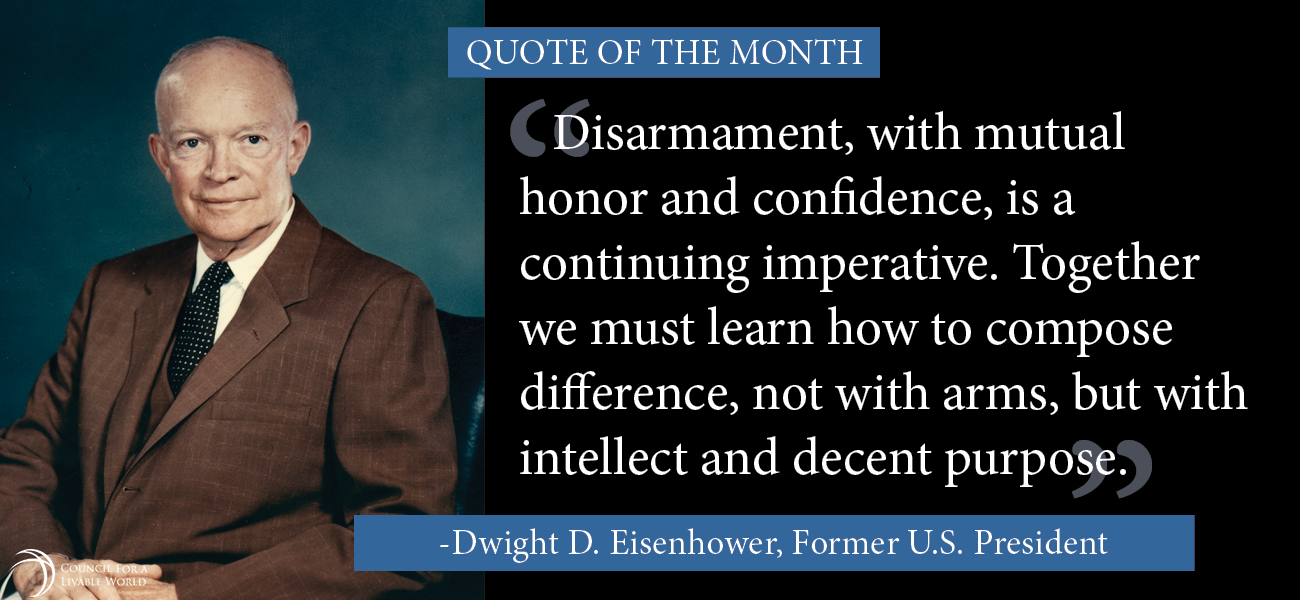
65 YEARS LATER, EISENHOWER’S WARNINGS RING TRUER THAN EVER Sixty-five years ago today, President Dwight D. Eisenhower gave his farewell address — a famous speech in which he warned about the dangers of the military-industrial complex, a phrase largely credited to him to explain their self-serving and mutually dependent relationship and the ways in which industry could be allowed to dictate foreign and defense policy. Watch the video | read the transcript. “This conjunction of an immense military establishment and a large arms industry is new in the American experience. The total influence — economic, political, even spiritual — is felt in every city, every state house, every office of the federal government. We recognize the imperative need for this development. Yet we must not fail to comprehend its grave implications. Our toil, resources and livelihood are all involved; so is the very structure of our society. In the councils of government, we must guard against the acquisition of unwarranted influence, whether sought or unsought, by the military-industrial complex. The potential for the disastrous rise of misplaced power exists and will persist. We must never let the weight of this combination endanger our liberties or democratic processes. We should take nothing for granted. Only an alert and knowledgeable citizenry can compel the proper meshing of the huge industrial and military machinery of defense with our peaceful methods and goals, so that security and liberty may prosper together.“ Now, several wars and a trillion-dollar Pentagon budget later, Eisenhower’s words still ring true. Dan Grazier at the Stimson Center explained how in an article for Responsible Statecraft: “In a city where partisanship and political rancor impacts nearly every debate, wasteful and ineffective defense policies are a conspicuous exception. That is because the National Security Establishment is party-agnostic. Military contractors donate money to candidates and lobbyists on both sides of the aisle, those candidates vote for Pentagon budget increases and fund weapons programs long after their failures are widely known, and lobbyists and corporate-sponsored media groups generate public support for those programs. Without massive structural changes, this pattern is all but certain to continue into future generations.” We are the “alert and knowledgeable citizenry” Eisenhower said could stop the military-industrial complex from gaining too much power. It’s not too late. We can — and must — urge our Members of Congress to conduct the oversight with which the body is tasked. We can — and must — speak out against the undue influence large defense corporations have over U.S. policy and consider how the massive Pentagon budget could be utilized to maximize national security while avoiding waste. And we can — and must — elect to Congress people who will prioritize diplomacy over military conflict, will hold the Pentagon accountable and will be guided by the county’s interests, not profit. |
|
IRANIAN PROTESTS CONTINUE AS TRUMP THREATENS INTERVENTION Protests across Iran, initially sparked by dire economic conditions and now calling for the end of Iran’s clerical establishment, have been met with violent and deadly crackdowns by Iranian security forces. In response to the violence, President Trump has warned of potential U.S. intervention. On January 14, in the face of the threat of intervention and increased sanctions, Iranian President Masoud Pezeshkian announced that his government plans to enact economic reforms to address grievances by protesters. All this follows the June 2025 U.S. attacks on Iranian nuclear facilities and the September 2025 reimposition of EU sanctions on Iran. The situation is rapidly developing. |
|
CHINA EYES UNITED STATES, JAPAN AS IT CONTINUES BUILDING UP ARSENAL The late December Pentagon assessment of China’s nuclear trajectory — including claims about silo loading and Beijing’s lack of interest in arms control — prompted an almost reflexive Chinese response: Washington, as the world’s largest nuclear power, should disarm first. It’s a familiar line, but it landed in the context of growing evidence that China is moving from “minimum deterrence” rhetoric toward a force that looks increasingly like a true peer competitor’s arsenal. Beijing also kept one eye on Japan this past month. An official Chinese report cited a purported message from then-President Joe Biden to Chinese President Xi Jinping warning Japan could produce nuclear weapons virtually overnight, folding Japan’s latent capability into China’s broader story that regional instability is being driven by U.S. alliances and external pressure, not by China’s own expanding arsenal. |
|
NORTH KOREA CLAIMS NEW NUCLEAR CAPABILITIES AS SOUTH KOREA SEEKS U.S. NUCLEAR COOPERATION North Korea closed out December by leaning hard into “second-strike” optics, releasing new imagery of what Pyongyang claims is a nuclear-powered strategic missile submarine. This is the kind of platform the regime wants the world to associate with survivable nuclear retaliation, however there is open skepticism about how close the North truly is to accomplishing its submarine goals. As January opened, the North conducted its first missile launch of 2026 when it sent at least two ballistic missiles into the East Sea and claimed they were the regime’s new hypersonic weapons. Political temperature rose too when North Korea accused South Korea of flying drones into its territory and promised retaliation, while Kim Yo Jong, member of the State Affairs Commission of North Korea and the sister of Kim Jong Un, publicly dismissed any near-term improvement in inter-Korean ties. Meanwhile, Seoul reportedly launched an intergovernmental consultative body meant to coordinate nuclear cooperation discussions with the United States — a reminder that South Korea is interested in building more durable channels for deterrence while Pyongyang keeps widening its menu of nuclear options. |
|
INDIA, PAKISTAN COMPLY WITH TRANSPARENCY MEASURES DESPITE TENSIONS Even as India and Pakistan remain stuck in the long shadow of last year’s military crisis, early January brought a small but telling reminder that the two sides still preserve some basic guardrails. Reporting indicated the two nations exchanged lists of nuclear installations under longstanding bilateral arrangements, one of the few regularized mechanisms that still survives periods of heightened tension. |
|
DOES THE PRESIDENT HAVE ANY LIMIT FOR SPENDING? President Trump wasted no time in 2026 continuing his foreign policy disaster class. In a January 7 social media post, the President called for Congress to provide $1.5 trillion (that’s $1,500,000,000,000) in fiscal year 2027. That stunning number would represent a more than 50% increase over fiscal year 2026’s already staggering $900 billion (plus an additional $100 billion from the Big Beautiful Bill). We are ready to push back against this fiscal madness in 2026 with your support. |
|
COUNCIL STAFF ATTEND BIPARTISAN RECEPTION CELEBRATING AUMF REPEALS On January 13, Council Senior Fellow John Isaacs and Political Director Connor Murray attended a Senate reception celebrating the repeals of the 1991 and 2002 Authorizations for Use of Military Force (AUMF) against Iraq. The reception was co-hosted by Sens. Tim Kaine (D-VA) and Todd Young (R-IN). It was a worthwhile reminder of the value of perseverance being surrounded by colleagues who have been partners on this effort for decades. Unfortunately, despite his commendable leadership on this issue, Sen. Young helped kill the war powers resolution on Venezuela just 24 hours later. |
|
COUNCIL CANDIDATES CAN CHANGE CONGRESS AND THE COUNTRY FOR THE BETTER With the midterm elections only 10 months away, Council for a Livable World’s political team is hard at work engaging candidates and their campaigns. We are prepared to support candidates who are ready to make a change in leadership in the House and Senate, conduct important oversight and keep us all safer. To that end, we are encouraged by recent reporting and insight from our own research and by other independent political analysts. More than a dozen races recently shifted in favor of progressive candidates and a change in majority in the House at least looks within reach. Consider supporting Council-endorsed candidates today and help us shape the leadership in the next Congress. For the next 10 months, we’ll list all of our endorsed candidates at the bottom of this newsletter along with their bios and donation links. If you’d like to donate to more than one House candidate or more than one Senate candidate, or donate to one or more candidates in each chamber, bookmark these links, which we’ll update through November every time we make a new endorsement: all endorsed House candidates | all endorsed Senate candidates | all endorsed candidates. |
|
FOLLOW US ON SOCIAL MEDIA We are on X (formerly known as Twitter), Facebook, Instagram, Threads and Bluesky. Follow us for the latest national security, legislative, campaign and nuclear weapons news on your favorite platforms. |
|
CONSIDER BECOMING A MONTHLY DONOR As election season nears, the Council is also hard at work on its advocacy on Capitol Hill. Have you considered making a monthly donation to support our efforts to reduce and eventually eliminate nuclear threats through political action? You can donate as little as $1 a month. Become a monthly supporter today!
|
2026 ENDORSED CANDIDATES |
|
|
|